
Who Inherits Without a Will in Texas?
Who inherits without a will in Texas? The answer depends on the deceased person’s family relationships, whether a spouse survives, and whether the property is community property or separate property. Texas calls these inheritance rules intestate succession. A surviving spouse does not always inherit everything, and the person who handled the deceased person’s finances does not automatically receive the estate.
Understanding who the heirs are is the first step. The family may also need a judicial determination of heirship, an estate administration, or another appropriate procedure to establish ownership and complete transfers.
How Does Texas Law Determine Who Inherits Without a Will?
A person who dies without a valid will dies intestate. Intestate succession is the legal process for determining who inherits the property that passes under the state’s inheritance laws. Texas also calls these rules the laws of descent and distribution.
These rules can apply even when someone leaves a will. If the will fails to dispose of part of the probate estate, that portion may pass by intestate succession. However, an asset does not have to appear by name in the will to pass under it; a properly drafted residuary clause may cover property the will does not specifically describe.
The rules do not necessarily produce the result the deceased person would have chosen. A valid will allows a person to select beneficiaries and address family circumstances within the limits of applicable law.
Who are a Person’s Legal Heirs?
To determine who inherits without a will in Texas, you must first identify the deceased person’s legal heirs. Depending on the circumstances, they may include a surviving spouse, children, grandchildren, parents, siblings, nieces, nephews, or more distant relatives. Their relationships determine who inherits and the share each person receives.
A relative’s place in the family tree matters. For example, a surviving parent generally does not inherit through intestate succession when the deceased person leaves children or other descendants. A niece does not necessarily inherit merely because she was closer to the deceased person than other relatives.
An heir and a beneficiary are not always the same person. A will can name a friend or charity as a beneficiary even though that person or organization would not qualify as an heir. Likewise, an heir may receive nothing under a valid will that leaves the property to someone else, subject to applicable legal protections and claims.
Which Assets Pass to Heirs Without a Will in Texas?
Intestate succession generally governs the deceased person’s probate property that does not pass under a valid will. Examples may include an individually owned bank account without a valid beneficiary designation or an interest in real estate without an effective transfer arrangement.
Other assets may pass directly under a beneficiary designation, survivorship agreement, trust, or other arrangement. Common examples include life insurance with a valid designated beneficiary and bank accounts with an effective payable-on-death designation. The governing documents and applicable law determine who receives those assets.
Review the ownership and beneficiary records before calculating anyone’s inheritance. A child could inherit a probate share and also receive a separate payable-on-death account. Conversely, someone who qualifies as an heir may have no right to an account payable directly to another beneficiary.
Why does Community or Separate Property Matter?
Determining who inherits without a will in Texas requires more than identifying the surviving relatives. When a married person dies, the property’s classification as community or separate property also affects each heir’s share.
Community property generally consists of property either spouse acquires during marriage other than separate property. Separate property generally includes property owned before marriage and property received individually by gift or inheritance during marriage. Certain personal injury recoveries also qualify, with statutory exceptions.
Property in either spouse’s possession during or at the end of marriage carries a presumption of community ownership. The name on a deed or account does not, by itself, settle whether the property is community or separate. Records showing when and how someone acquired the property can be essential.
Your attorney should classify the property before applying inheritance percentages. The deceased person’s estate includes the deceased person’s ownership interest; it does not automatically include everything the surviving spouse owns.
Who Inherits Community Property Without a Will in Texas?
When a married person dies without a will in Texas, the surviving spouse keeps their own one-half community property interest. Who inherits the deceased spouse’s half depends on the deceased spouse’s surviving children and other descendants:
- No children or other descendants survive: The surviving spouse inherits the deceased spouse’s half.
- All surviving descendants are also descendants of the surviving spouse: The surviving spouse inherits the deceased spouse’s half.
- At least one surviving descendant is not also a descendant of the surviving spouse: The deceased spouse’s half passes to the deceased spouse’s children or other descendants under Texas inheritance law. This includes all qualifying descendants, not just those from another relationship.
The chart below shows how these rules affect ownership of the entire community asset. The same rules generally apply to community real estate and community personal property.
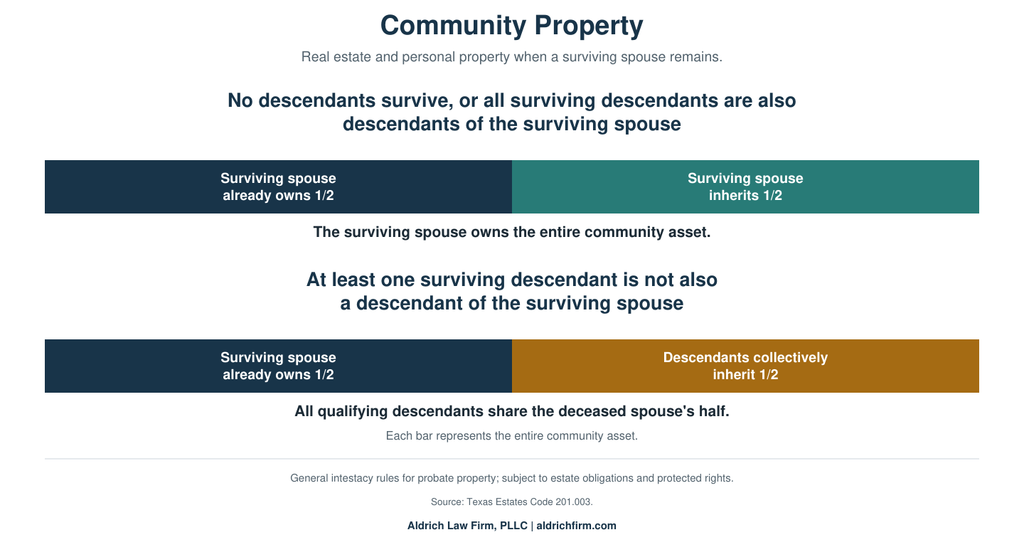
For example, assume a husband dies without a will, leaving his wife and two living children from a previous relationship. The couple owns a house entirely as community property, with no survivorship agreement or other transfer arrangement. The wife retains her one-half ownership interest, and each child generally inherits one-fourth of the whole property from the husband’s half.
These ownership shares remain subject to applicable estate obligations and legal protections. For example, the surviving spouse may have a protected right to occupy the homestead even when the deceased spouse’s children inherit an ownership interest.
Who Inherits Separate Property Without a Will in Texas?
When the deceased person leaves a surviving spouse and children or other descendants, the rules distinguish personal property from real estate:
- Separate personal property: The surviving spouse inherits one-third. The children or other descendants inherit the remaining two-thirds under the statutory distribution rules.
- Separate real estate: The surviving spouse receives a life estate in one-third. The children or other descendants receive the remaining ownership interests, including the remainder interest in the spouse’s one-third life estate.
Personal property includes assets such as money, vehicles, and household belongings. Real property includes land and houses. A life estate generally gives someone rights to use and possess property during that person’s lifetime; it does not give the same ownership as an outright inheritance.
For example, assume a wife dies without a will, leaving her husband and two living children. She owns $90,000 in separate funds that belong to the probate estate. Before considering debts, expenses, or other adjustments, the husband’s share is $30,000, and each child’s share is $30,000. These separate-property rules apply even if both children are also the husband’s children.
What If There is a Spouse but No Children or Other Descendants?
When someone dies without a will in Texas and leaves a surviving spouse but no children or other descendants, the surviving spouse inherits the deceased spouse’s community property interest and all separate personal property. The inheritance of separate real estate depends on which other relatives survive.
If the deceased person leaves a surviving parent, sibling, or descendant of a sibling, the surviving spouse generally inherits one-half of the separate real estate outright. The other half passes to those relatives under the applicable inheritance rules. If none of those relatives survives, the surviving spouse inherits all of the separate real estate.
The chart below compares these rules with the separate-property rules that apply when children or other descendants survive:
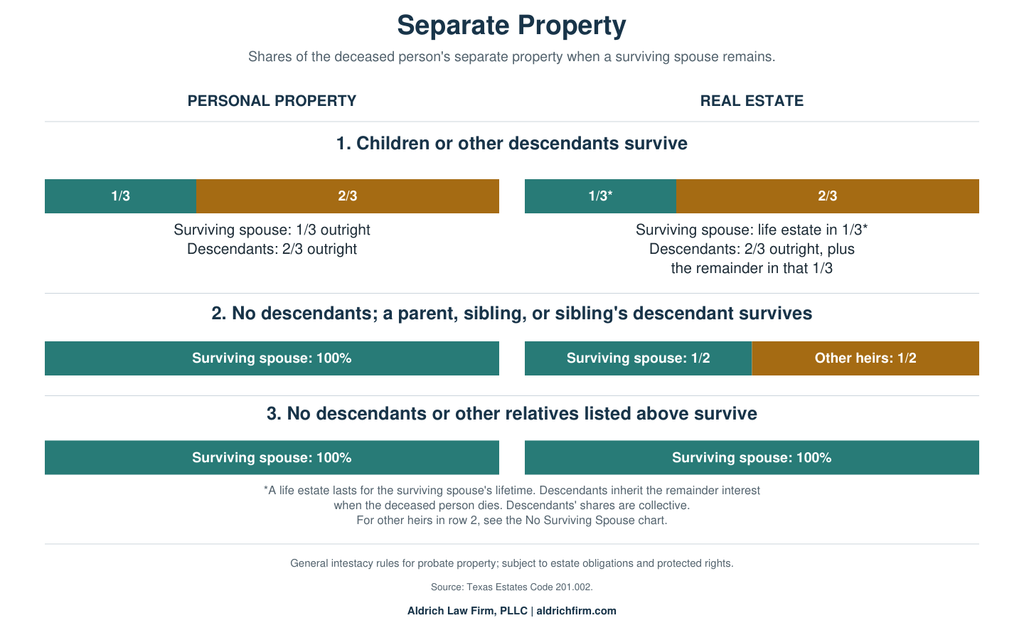
A married couple without children should therefore not assume that the surviving spouse will automatically inherit everything. For example, if one spouse owns a house as separate property, that spouse’s parents, siblings, or descendants of siblings may inherit an ownership interest. A will can help the couple address that possibility and specify who should receive the property.
Who Inherits Without a Will in Texas If There is No Spouse?
When someone dies without a will in Texas and leaves no surviving spouse, children or other descendants generally inherit the probate estate. If no descendants survive, the law looks to parents, siblings, descendants of deceased siblings, and then more distant relatives.
The chart below summarizes who inherits based on which relatives survive. These rules apply to both the deceased person’s real estate and personal property that pass by intestate succession.
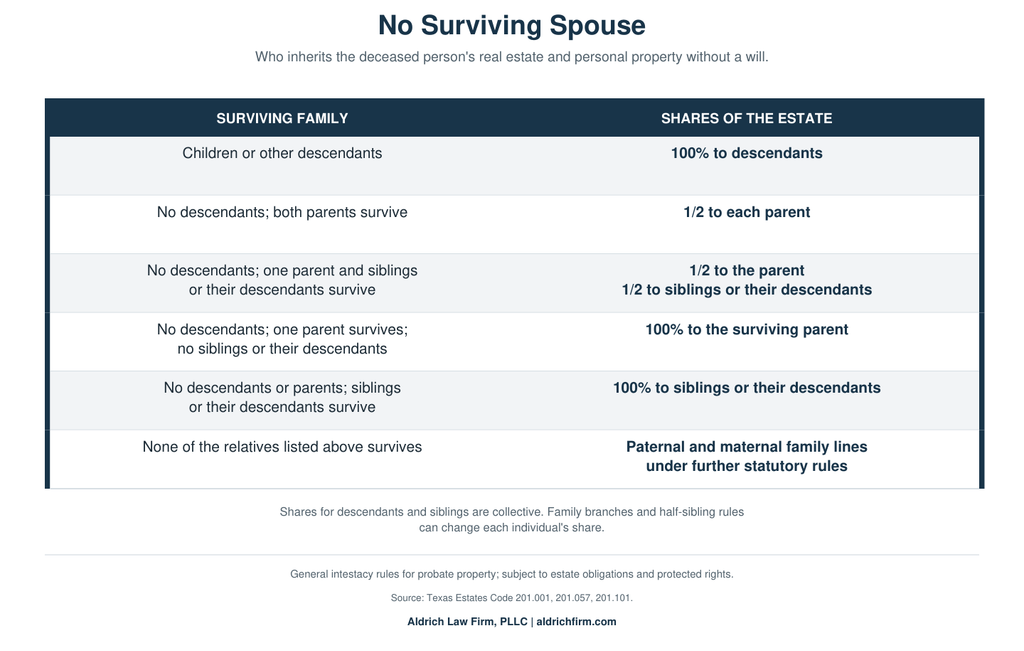
The shares shown for descendants and siblings belong to those groups collectively. For example, “one-half to siblings or their descendants” means that the qualifying relatives share that half; it does not mean each person receives one-half of the estate.
The individual shares depend on the family tree. Descendants of a deceased relative may inherit through that relative’s branch, and different rules can apply when full siblings and half-siblings inherit together. Your attorney should review the complete family history before calculating or distributing anyone’s share.
What Happens If a Child Died Before the Parent?
A deceased child’s descendants may inherit through that child’s family branch. When determining who inherits without a will in Texas, the family must account for children who died earlier and any descendants they left behind.
For example, assume a mother dies without a spouse or will. One son survives her. A daughter died earlier and left two children who survive their grandmother. The son generally inherits one-half, and the daughter’s two children split the other half, receiving one-fourth each.
Do not apply that example mechanically to every family tree. When all children have died, or descendants in several generations survive, the statutory rules require a more detailed calculation. Your attorney needs the complete family history and the order of deaths.
Do Adopted Children and Stepchildren Inherit?
A legally adopted child generally inherits from and through the adoptive parents as a biological child would. Adoption can also raise questions about inheritance through biological relatives, so provide the adoption records rather than assume that adoption ended every inheritance right.
A stepchild generally does not inherit from a stepparent through intestate succession solely because of the stepchild relationship. If the stepparent adopted the child, the analysis changes. Raising or supporting a child, without more, does not automatically establish the same inheritance rights as a legal parent-child relationship.
Children born outside marriage may also inherit. Questions about legal parentage, acknowledgments, court orders, and other evidence can affect the determination. Tell your attorney about every child and any uncertainty about parentage, including children from earlier relationships.
Do Half-Siblings Inherit the Same Share as Full Siblings?
Not always. When an estate passes to collateral relatives, such as siblings, Texas distinguishes relatives of the whole blood from relatives of the half blood. When both inherit, a half-sibling generally receives half the share of a full sibling. If all inheriting siblings are half-siblings, they generally receive whole shares.
For example, assume a person dies without a spouse, descendants, or surviving parents, leaving one full sibling and one half-sibling, both living. The full sibling generally receives two-thirds, and the half-sibling receives one-third.
This rule does not reduce a child’s inheritance merely because the child and another child have different mothers or fathers. The distinction concerns their relationship to the deceased person.
Can an Unmarried Partner or Estranged Relative Inherit?
A boyfriend, girlfriend, or unmarried partner generally does not qualify as a surviving spouse merely because the couple lived together for many years. However, a valid informal marriage, often called a common-law marriage, can establish spousal inheritance rights. Living together alone does not establish that marriage; Texas requires additional elements.
Estrangement alone generally does not eliminate an heir’s inheritance rights. A child who rarely visited may still inherit, while a friend who provided daily care may receive nothing under intestate succession. The law does not automatically award a larger share to the person who provided the most care or paid the most expenses.
A reimbursement claim, agreement, or other legal issue may require separate review. Explain those circumstances to your attorney before distributing the estate.
What If an Heir Died Shortly After the Deceased Person?
The timing can change the result. Texas generally requires an intestate heir to survive the deceased person by 120 hours, subject to statutory exceptions.
If an heir survives long enough to inherit and later dies, the inherited interest generally becomes part of that heir’s estate. It does not automatically return to the first person’s estate for redistribution among the remaining relatives.
Bring death certificates and explain the sequence of deaths. The family may need to address more than one estate to establish the current ownership interests.
How Do We Establish Who Inherits Without a Will in Texas?
A judicial determination of heirship allows the court to identify the heirs and their respective interests. Families often pursue that determination together with an administrator’s appointment when someone needs authority to collect assets, address debts, and complete estate business.
Determining who inherits without a will in Texas does not automatically authorize one heir to act for everyone else. An heirship judgment establishes inheritance rights, while an administrator’s appointment gives someone authority to administer the estate. Family agreement can simplify the case, but a bank or title company may still require formal documentation.
Some estates qualify for another approach, such as an affidavit of heirship for an appropriate real estate transaction or a court-approved small estate affidavit. Those procedures have different requirements and effects. Your attorney should review the assets and the institution’s requirements before recommending a procedure.
Does an Inheritance Share Mean We Can Distribute Everything Immediately?
No. Although inheritance rights generally arise at death, estate property remains subject to applicable debts, administration requirements, and other legal obligations. An ownership percentage does not establish that the entire account balance is available for immediate distribution.
Homestead rights and other protections may also affect how the family can use or transfer property. For example, a surviving spouse may have a protected right to occupy a homestead even when children inherit an ownership interest.
Before transferring funds or signing a deed, discuss the estate’s obligations and the proposed transaction with your attorney. Keep estate funds separate from personal funds and retain records of receipts, expenses, and distributions.
Help Determining Heirs in San Antonio and Bexar County
The Aldrich Law Firm, PLLC helps families determine who inherits under Texas law and obtain the documents needed to administer estates and transfer property. We can review the family history, distinguish community property from separate property, and determine whether an heirship proceeding or another procedure fits the estate.
Contact our San Antonio office to discuss who inherits without a will in Texas, your family’s circumstances, and the steps needed to establish the heirs’ interests.