
My Parent Died with a Will in San Antonio. What Do I Do Next?
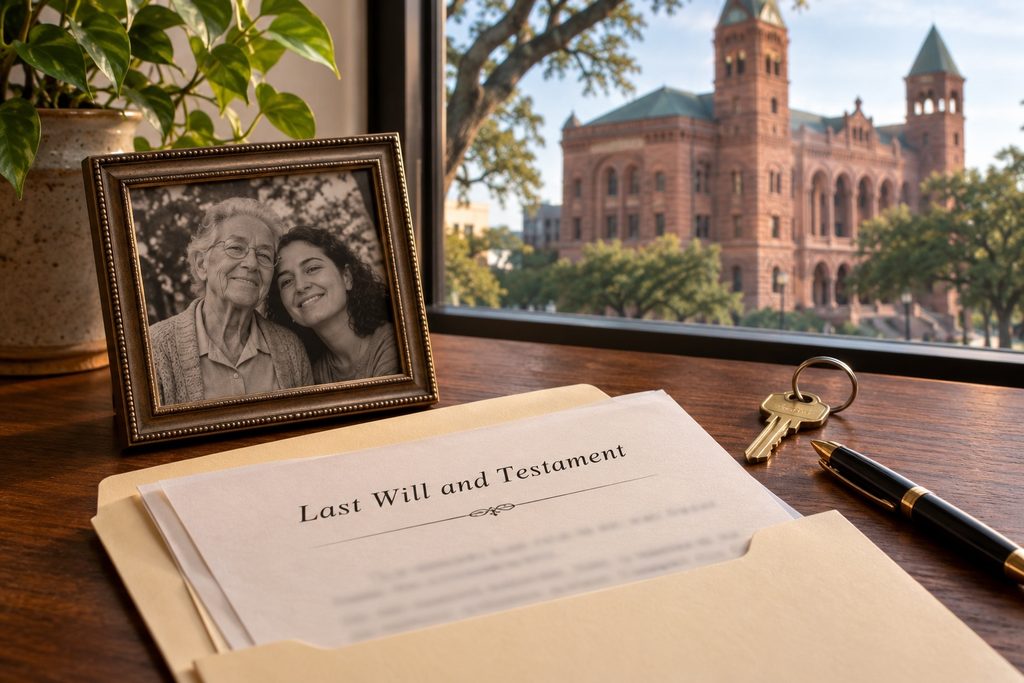
If your parent died with a will, you may need to begin probate in San Antonio before anyone can access estate accounts, transfer certain property, or distribute an inheritance. Your first steps should include locating the original will, protecting your parent’s property, and gathering information for a probate attorney.
A will explains how your parent wanted to distribute property and whom they wanted to serve as executor. However, being named executor does not automatically give someone authority to act for the estate. The appropriate next steps depend on the will, the assets, and whether the estate needs administration.
What Should I Do First?
You do not need to resolve every estate issue immediately. Start by preserving the documents and property that your attorney will need to evaluate:
- Locate the original will and any amendments. An amendment to a will is called a codicil. Keep these documents together and avoid writing on them or removing staples.
- Obtain certified death certificates. Your attorney and financial institutions can help you determine how many copies you may need.
- Protect the property. Secure the home, preserve important records, and arrange necessary care for pets and other property.
- Identify the named executor. Find out whether that person knows about the appointment and can serve.
- Gather basic financial information. Collect statements, deeds, insurance information, and a preliminary list of debts.
- Contact a probate attorney before distributing assets. Family agreement alone does not establish who has authority to transfer estate property.
Keep receipts for expenses you pay personally. Your attorney can explain whether the estate may reimburse appropriate expenses and what records you should retain.
Where Should I Look for the Original Will?
Check your parent’s important papers, home safe, and estate planning files. If you know which attorney prepared the will, contact that office to ask whether it holds the original or knows where your parent kept it.
A copy can help your attorney identify the executor and understand the estate plan, but it does not always substitute for the original. If you can find only a copy, explain that at the beginning of the consultation. Texas permits probate of a missing original in some circumstances, but the proceeding requires additional proof.
Avoid assuming that a missing original means the estate must proceed as though your parent never made a will. Your attorney should evaluate the circumstances and available evidence. Learn more about probating a will when the original is missing.
Texas law also requires a person holding a deceased person’s will to deliver it to the clerk of the court with jurisdiction. Delivering the will and applying to probate it are separate steps; ask your attorney how to handle both.
Can I Protect the House Before an Executor is Appointed?
Take reasonable steps to prevent loss while your attorney determines who has authority to act. That may include securing doors, addressing an urgent leak, arranging lawn care, and documenting the home’s condition.
If the property will remain vacant, contact the insurance company or agent promptly. Ask how the vacancy affects coverage and whether the policy requires any action.
Protecting property does not give you unrestricted authority to sell it, remove belongings, or divide possessions among family members. Even personal items may belong to the estate, a surviving spouse, or another owner.
If someone has started removing property or accessing accounts, tell your attorney. Preserve relevant messages, photographs, statements, and other records so the attorney can assess whether the situation requires immediate attention.
Does Every Will Require Probate in San Antonio?
Not every asset passes under a will. Before choosing a probate procedure, your attorney should distinguish between probate assets and non-probate assets.
Probate assets generally pass through the deceased person’s estate. Examples may include an individually owned bank account without an effective beneficiary designation or real estate that lacks another legally effective transfer arrangement.
Non-probate assets generally pass under a separate agreement or designation. Examples may include:
- A bank account with a valid payable-on-death beneficiary.
- Property covered by an effective survivorship agreement.
- Life insurance payable to a named beneficiary.
- Retirement benefits with an effective beneficiary designation.
- Property held in a trust.
A will generally does not override a valid beneficiary designation or survivorship arrangement. Similarly, an authorized signer on a bank account does not necessarily own the funds or inherit them after the account owner’s death.
Before beginning probate in San Antonio, ask your attorney to review how your parent owned each asset and whether any beneficiary or survivorship designation applies. Bring account statements, deeds, and available ownership documents to the consultation. That review helps determine which assets require probate and which can transfer through another process.
What if My Other Parent is Still Living?
A surviving spouse’s rights can affect both ownership and administration. Your deceased parent’s will controls only property that the parent could legally dispose of through the will.
For example, a surviving spouse generally retains their own interest in community property. The surviving spouse may also have homestead rights and other statutory protections that affect how the estate handles particular assets.
Tell your attorney whether your parent was married at death, including whether anyone claims a common-law marriage. Also explain whether either spouse had children from another relationship and whether the spouses signed any marital property agreements.
These details help your attorney distinguish the deceased parent’s property from property belonging to the surviving spouse and evaluate the surviving spouse’s rights.
Can the Named Executor Start Using Estate Accounts?
Being named executor expresses your parent’s choice. The court must still appoint the executor, and the executor must qualify before the clerk issues letters testamentary.
Qualification requires the appropriate oath or authorized declaration. If a bond is required, the executor must also satisfy that requirement and obtain the necessary approval.
Banks commonly request letters testamentary to verify the executor’s appointment and qualification. Giving the bank a copy of the will may not provide enough authority to access an estate account.
If a bank requests letters, obtain its document requirements in writing. Ask whether the account has a beneficiary or survivorship designation before assuming that probate is necessary. Our article about obtaining letters testamentary in Texas explains that process in more detail.
Can I Continue Using My Parent’s Power of Attorney?
A durable power of attorney generally terminates when the person who granted it dies. “Durable” means the authority can continue during incapacity; it does not mean the authority continues after death.
Even if you managed your parent’s finances for years, the power of attorney does not authorize you to continue acting for the estate after death. Your authority must come from another valid source, such as a court appointment or your own ownership rights.
Tell your attorney about transactions that occurred around the time of death and any payments that still need attention. Avoid assuming that access to a debit card, account login, or checkbook gives you legal authority to use estate funds.
Which Court Handles Probate in San Antonio?
For a Texas resident, probate venue generally depends on the county where the deceased person had a domicile or fixed residence. The location of the hospital where your parent died does not necessarily determine where to file. Your own residence does not determine it either.
If your parent lived in Bexar County, the proceeding will generally belong in a Bexar County probate court. However, a San Antonio mailing address does not always resolve the county question. Your attorney should confirm the proper county before filing.
This matters if your parent recently moved, lived in a care facility, owned homes in different locations, or spent substantial time outside Texas.
Do I Need an Attorney for Probate in San Antonio?
For an application seeking letters testamentary in Bexar County, you should expect to retain an attorney. Bexar County’s published probate guidance explains that an executor represents interests beyond the executor’s own, including those of beneficiaries and creditors.
You do not need to be an attorney to serve as executor. However, the court generally requires counsel for the proceeding seeking the executor’s appointment and letters. Different procedures may have different requirements.
Your attorney can review the will, identify the appropriate procedure, prepare the application, and explain the responsibilities that follow appointment.
Will the Estate Need an Executor?
An estate that requires someone to collect assets, handle obligations, and distribute property may need an executor. An independent administration, when available, allows the executor to handle many administration tasks without obtaining separate court approval for each action.
Some estates qualify for probate as a muniment of title. In that procedure, the court admits the will without appointing an executor or issuing letters testamentary. The will and order serve as evidence supporting property transfers.
Eligibility generally requires that the estate have no unpaid debts other than those secured by liens on real estate, or that the court otherwise find no need for administration. Your attorney must also determine whether the procedure will accomplish the necessary transfers.
A muniment of title may simplify a qualifying estate, but it will not supply letters if an institution properly requires a court-appointed representative.
How Long Does Probate in San Antonio Take?
For a simple, uncontested will, allow approximately four to six weeks from filing the application to the probate hearing as a planning estimate. That estimate does not include the time needed to locate documents and prepare the application.
The actual setting depends on required notice, the assigned court’s calendar, and whether the documents are ready. Holidays, missing originals, qualification issues, or disagreements can extend the process.
At the hearing, the court considers whether to admit the will and appoint the executor. The executor must then complete the applicable qualification requirements before receiving letters.
The hearing does not finish the estate. Collecting assets, selling property, addressing debts, and arranging distributions may take several additional months or longer.
What Happens After the Executor Receives Letters?
Letters begin the executor’s work of administering the estate. Depending on the circumstances, that work may include collecting funds, maintaining property, providing notices, preparing an inventory, addressing creditor claims, and handling tax matters.
If the executor needs an estate bank account, the estate may also need its own Employer Identification Number (EIN). The IRS provides information for executors, including guidance about obtaining an EIN.
The executor should keep estate funds separate from personal funds and preserve records of receipts and expenses. Before making distributions, the executor should discuss outstanding obligations and appropriate reserves with the attorney.
Receiving money from a bank does not establish that the entire balance is immediately available for beneficiaries.
How Soon Should I Contact a Probate Attorney?
Contact an attorney once you have located the will or determined that you cannot find it. You do not need a complete inventory before scheduling a consultation.
Texas generally requires presenting a will for probate within four years after death, subject to a limited exception. That deadline is not a recommended waiting period. Delays can complicate access to accounts, property transfers, and the preservation of records.
Tell your attorney immediately about a pending property sale, threatened foreclosure, suspected removal of assets, or disagreement concerning the will. Those circumstances may require attention before the ordinary probate process concludes.
Help with Probate in San Antonio
If your parent died with a will, the Aldrich Law Firm, PLLC can review the documents, identify which assets require probate, and explain the steps needed to appoint an executor or use another appropriate procedure.
Bring the original will, any codicils, a death certificate if available, and basic information about the family, assets, and debts. Contact our San Antonio office to discuss your parent’s estate and what to do next.