
Probate vs. Non-Probate Assets in Texas: What is the Difference?

When someone dies, not everything they owned necessarily passes under their will. Non-probate assets generally transfer through a beneficiary designation, survivorship agreement, trust, or another legally effective arrangement. Probate assets pass through the deceased person’s estate, either under a will or under Texas inheritance law.
Understanding the difference helps families determine who receives particular property, what documents they need, and whether a probate proceeding is necessary. The answer depends on how each asset was owned and what transfer arrangements were in place—not simply on whether the deceased person left a will.
What are Probate Assets?
Probate assets are property interests that pass through the deceased person’s estate. If the person left a valid will, its terms generally determine who receives those assets, subject to debts, administration requirements, and other applicable rights. Without a will, Texas intestate succession law determines the heirs and their shares.
Common examples include:
- A bank account owned solely by the deceased person without an effective beneficiary designation.
- The deceased person’s interest in real estate without an effective survivorship agreement, transfer-on-death deed, or other arrangement.
- An individually owned investment account without an effective transfer-on-death designation.
- Personal belongings, such as furniture, jewelry, and collectibles, that the deceased person owned individually.
- Certain business interests, depending on the governing agreements and ownership structure.
Calling property a probate asset does not mean every estate requires the same court procedure. Depending on the circumstances, an estate may qualify for administration, probate as a muniment of title, or another available process.
What are Non-Probate Assets?
Non-probate assets generally pass outside the probate estate under a legally effective transfer arrangement. The account agreement, beneficiary designation, deed, or trust determines who receives the property.
Common examples include:
- Bank accounts with valid payable-on-death beneficiary designations.
- Accounts covered by effective rights of survivorship.
- Life insurance payable to a surviving named beneficiary.
- Retirement accounts payable to an eligible designated beneficiary.
- Real estate covered by a valid transfer-on-death deed.
- Assets properly held in a trust.
Texas law recognizes several types of contractual and other non-probate transfers. However, an asset’s classification depends on the actual documents and applicable law. Calling an account “joint” or writing someone’s name on a financial worksheet does not necessarily establish a valid transfer arrangement.
Common Examples of Probate and Non-Probate Assets
The following examples assume valid documents, effective designations, and no ownership dispute:
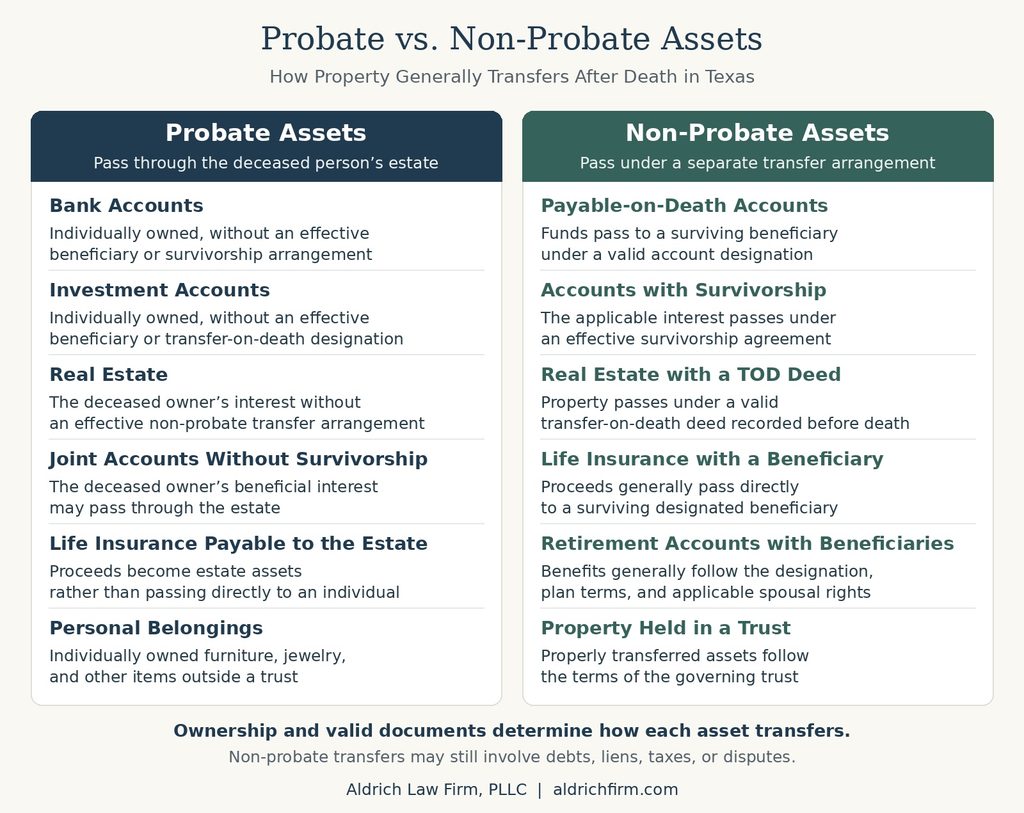
The type of asset alone does not answer the question. Two bank accounts at the same institution can follow different transfer processes because their ownership and beneficiary arrangements differ.
Does a Will Control Non-Probate Assets?
A will generally does not override a valid beneficiary designation or survivorship agreement. Those arrangements can transfer property to someone other than the beneficiaries named in the will.
For example, assume your mother’s will leaves her probate estate equally to you and your brother. She also owns a bank account naming you as its sole payable-on-death beneficiary. If the designation is valid and you satisfy the applicable requirements, that account generally passes to you outside the will.
Your brother’s equal share under the will does not automatically entitle him to half of that account. The will ordinarily governs the probate estate, while the account agreement governs the beneficiary transfer.
This distinction can produce a different result from what family members expected. Review beneficiary designations alongside the will, rather than assuming that updating one automatically updates the other.
Does a Joint Bank Account Automatically Avoid Probate?
No. Multiple names on an account do not automatically establish a right of survivorship. Texas law distinguishes ownership during life, authority to make transactions, and the right to receive funds after death.
An authorized signer may have permission to help pay bills without owning the money or inheriting the balance. Similarly, a joint owner’s ability to withdraw funds does not necessarily establish ownership of the entire account after another owner dies.
Ask the bank for the signed account agreement, signature card, and any beneficiary or survivorship documents. Those records matter more than an employee’s informal description of the account.
Chapter 113 of the Texas Estates Code explains the rules governing multiple-party accounts, including payable-on-death and survivorship arrangements.
How Do Life Insurance and Retirement Accounts Transfer?
Life insurance and retirement accounts commonly qualify as non-probate assets when an effective beneficiary designation directs payment outside the estate.
The beneficiary generally submits a claim to the insurance company or plan administrator. The institution may require a death certificate, identification, claim forms, and additional supporting documents.
However, do not assume that the account will avoid probate merely because it allows beneficiary designations. If the owner named the estate, never completed a designation, or outlived the named beneficiaries, the policy or plan’s default provisions may determine the recipient. In some circumstances, payment goes to the estate.
Retirement accounts also involve special rules, including possible surviving-spouse rights and federal requirements. Your attorney should review the designation and plan documents before treating an expected payment as settled.
Can a House Be a Non-Probate Asset?
Yes. A house can pass outside probate through a valid transfer-on-death deed, effective survivorship arrangement, or properly established trust ownership.
A Texas transfer-on-death deed must satisfy statutory requirements, including recording before the owner’s death. Naming someone in an unrecorded document does not accomplish the same result.
The beneficiary also receives the property subject to applicable liens and other interests. A transfer-on-death deed does not erase a mortgage or guarantee clear title. Texas law may also permit recovery against the transferred property for certain estate obligations when other estate assets are insufficient.
If the deed simply names two people as owners, do not assume the surviving owner automatically receives the deceased owner’s share. Have an attorney review the deed and any related agreements.
Does Community Property Automatically Pass to the Surviving Spouse?
No. Community property describes ownership during marriage; it does not, by itself, create a right of survivorship.
A surviving spouse generally retains their own community interest. What happens to the deceased spouse’s interest depends on the will, Texas inheritance law, or an effective non-probate transfer arrangement.
For example, a house can be community property while the deceased spouse’s interest remains part of the probate estate. Alternatively, an effective survivorship agreement may provide for that interest to pass directly to the surviving spouse.
Separate property can also fall into either category. An inherited bank account might remain separate property while passing outside probate through a valid payable-on-death designation.
These are different questions: Who owned the property during life, and how does that ownership interest transfer at death?
Does Creating a Trust Keep Everything Out of Probate?
Creating a trust does not automatically make every asset a non-probate asset. The owner must also take the steps needed to place the appropriate property in the trust or arrange for it to transfer there.
For example, signing a trust agreement does not necessarily transfer an individually owned house into the trust. Your attorney should review the deed and other relevant documents.
Likewise, a “pour-over will” may direct probate assets into a trust after death, but those assets may still require probate before they reach the trust.
Trust administration also involves responsibilities. Avoiding probate does not eliminate the trustee’s duties to follow the trust, maintain records, address applicable obligations, and distribute property appropriately.
What Happens if a Beneficiary Dies First?
The answer depends on the asset, its governing documents, and applicable law.
A designation may name a contingent beneficiary or explain how to distribute a deceased beneficiary’s share. A policy or account agreement may also supply default rules when no designated beneficiary survives.
Do not assume that the deceased beneficiary’s children automatically take that beneficiary’s place. Similarly, do not assume that every failed designation sends the asset to the owner’s estate.
Obtain the complete designation and governing agreement. An account statement showing a beneficiary’s name may not explain what happens if that person dies first.
Are Non-Probate Assets Protected from Every Creditor?
No. Passing outside probate does not establish that an asset is immune from every debt, lien, or claim. Different assets receive different protections, and some transfer arrangements remain subject to statutory recovery provisions.
For example, Texas law permits recovery of certain funds transferred through multiple-party accounts when other estate assets are insufficient to satisfy specified obligations. Special rules also apply to property transferred through a transfer-on-death deed.
Other assets may have substantial creditor protections under applicable law. Your attorney should evaluate the particular asset and claim rather than treating all non-probate assets alike.
Before spending or redistributing a substantial payment, ask whether any ownership dispute, lien, or potential recovery claim needs attention.
Does Avoiding Probate Also Avoid Taxes?
No. Probate classification and tax treatment are separate questions.
Property can pass outside probate and still count toward the deceased person’s gross estate for federal estate tax purposes. The IRS’s estate tax guidance explains that the gross estate may include real estate, insurance, trusts, and other property. Inclusion does not necessarily mean estate tax is due.
Income tax treatment also varies. For example, distributions from an inherited retirement account may have different consequences from receiving life insurance proceeds.
Your attorney and tax professional should evaluate the assets together. Avoiding a probate proceeding does not, by itself, eliminate tax reporting or payment obligations.
What if a Bank Requests Letters Testamentary?
Before opening probate solely because a bank employee requests letters, ask the bank to confirm the account’s ownership and beneficiary designation.
A valid beneficiary or survivorship claim may follow a different process from an executor’s request for estate funds. Ask for the bank’s document requirements in writing and obtain the relevant account records.
If employees give conflicting answers, request assistance from the department handling deceased customers’ accounts. Bring its response to your attorney.
Our article about obtaining letters testamentary in Texas explains how to evaluate these requests and obtain court authority when necessary.
Can an Estate Have Both Types of Assets?
Yes. An estate plan commonly includes both probate and non-probate assets.
For example, a parent may leave:
- A house that requires probate to transfer the deceased parent’s interest.
- A bank account payable directly to one child.
- Life insurance payable to another child.
- A retirement account payable to the surviving spouse.
The executor generally administers the probate assets. The beneficiaries pursue their separate claims for property passing outside the estate.
Consequently, a family may need probate of a will even when several valuable assets transfer directly to beneficiaries. Without a will, probate assets may instead require an heirship proceeding or another appropriate procedure.
What Documents Should I Bring to an Attorney?
Bring enough information to identify the assets and how the deceased person owned them. Useful documents include:
- The original will and any amendments.
- Trust agreements and amendments.
- Bank and investment statements.
- Account agreements, signature cards, and beneficiary designations.
- Deeds and any survivorship agreements.
- Life insurance policies and beneficiary information.
- Retirement account and employer benefit records.
- Information about mortgages, other debts, and potential disputes.
- A death certificate, if available.
You do not need every document before scheduling a consultation. Your attorney can identify missing records and explain how to request them.
Help Identifying Probate and Non-Probate Assets in Texas
Determining how property transfers after death requires more than reading the will. Account agreements, deeds, beneficiary designations, trust documents, and ownership rights can all affect the result.
The Aldrich Law Firm, PLLC helps families in San Antonio and throughout Texas identify probate and non-probate assets, evaluate transfer requirements, and choose an appropriate probate procedure. Contact our office to discuss the assets and the steps needed to transfer them.